
WEB DESIGN GLOSSARY: WEB DESIGN TERMS EXPLAINED
Your website is often the first impression a potential customer has of your business. Whether they're discovering your company through Google, social media or a recommendation, your website plays a crucial role in shaping how they perceive your brand.
If you're planning a new website or redesigning an existing one, you'll quickly discover that web design comes with its own terminology. During meetings with designers and developers, you may hear references to wireframes, UX, responsive design, CMS platforms or hosting. Whilst these are everyday terms within the industry, they can be unfamiliar if you've never been involved in a website project before.
Having a working knowledge of common web design terminology makes it easier to communicate your ideas, understand recommendations and make informed decisions throughout your project. It also helps you ask better questions and gain a clearer understanding of how your website is being planned, designed and built.
This glossary explains some of the most common web design terms in plain English. Rather than focusing on complex programming language, it covers the terminology that businesses are most likely to encounter when working with a web design agency.
And if you like this glossary, you’ll probably like our SEO glossary too!
WEBSITE PLANNING TERMS
Before any design work begins, careful planning helps ensure the finished website meets both business objectives and user needs.
BRIEF
A document outlining the purpose of the website, its target audience, business goals, desired functionality and overall requirements. A clear brief provides the foundation for a successful website project.
DISCOVERY WORKSHOP
An initial meeting where the client and web design team discuss objectives, competitors, target users and project requirements before work begins.
INFORMATION ARCHITECTURE
The process of organising a website's pages and content so visitors can easily find the information they're looking for.
SITEMAP
A visual plan showing every page that will exist on a website and how those pages connect together.
USER JOURNEY
The path a visitor takes through a website, from arriving on the homepage to completing a desired action such as making an enquiry or purchasing a product.
WIREFRAME
A simple layout showing the structure of a webpage before colours, images, and branding are added.
CONTENT STRATEGY
The planning of website content to ensure every page provides useful information while supporting business goals and search engine optimisation.
WEB DESIGN TERMS
These terms relate to the visual appearance and usability of a website.
ABOVE THE FOLD
The section of a webpage that is visible without scrolling. Important messaging and calls to action are often placed here.
CALL TO ACTION
A button or link encouraging visitors to take a specific action, such as requesting a quote, contacting your business or downloading a guide.
COLOUR PALETTE
The collection of colours used consistently throughout a website to reinforce branding and improve visual consistency.
FOOTER
The section displayed at the bottom of every webpage, often containing contact information, navigation links, copyright notices and legal pages.
HEADER
The area at the top of a webpage that typically includes the logo, navigation menu and primary call to action.
HERO SECTION
The large banner or introductory section displayed at the top of a webpage, designed to capture attention and communicate the page's main message.
NAVIGATION
The menus and links that help visitors move around a website.
Often also described as a Nav Bar, you’ll usually see it at the top of your screen on a website.
RESPONSIVE DESIGN
An approach to web design that ensures websites automatically adapt to different screen sizes, including desktops, tablets, and smartphones.
TYPOGRAPHY
The fonts, sizes and spacing used throughout a website to improve readability and reinforce brand identity.
USER EXPERIENCE (UX)
The overall experience a visitor has while using a website, including how easy it is to navigate, understand and complete tasks.
USER INTERFACE (UI)
The visual elements that users interact with, including buttons, menus, forms and page layouts.
WHITE SPACE
The empty areas between elements on a webpage that improve readability and create a cleaner, less cluttered design.
WEB DEVELOPMENT TERMS
Behind every website is a technical framework that allows everything to function correctly.
BACKEND
The server-side systems that power a website behind the scenes, including databases, user management and website functionality.
CMS (CONTENT MANAGEMENT SYSTEM)
Software that allows website owners to update content without needing coding knowledge. Popular CMS platforms include WordPress, Squarespace and Webflow.
CSS
A coding language used to control the appearance of a website, including colours, layouts, fonts and spacing.
DOMAIN NAME
The web address people type into their browser to visit a website, such as www.treefrog.uk.com.
DNS
The Domain Name System connects your domain name to the server where your website is hosted.
FRONTEND
The visible part of a website that visitors interact with through their web browser.
HOSTING
The service that stores your website's files and makes them available online.
HTML
The core coding language used to structure webpages.
JAVASCRIPT
A programming language that adds interactive features such as animations, forms, sliders and dynamic content.
PLUGIN
An additional piece of software that extends the functionality of a website without requiring custom development.
SSL CERTIFICATE
A security certificate that encrypts information transferred between a website and its visitors. Websites using SSL display https:// and a padlock icon in the browser.
WEBSITE PERFORMANCE & SEO TERMS
A well-designed website should not only look good but also perform well in search engines and provide an excellent user experience.
ACCESSIBILITY
Designing and developing websites so they can be used by as many people as possible, including those with disabilities or assistive technologies.
ALT TEXT
A written description added to images that helps screen readers describe visual content whilst also providing context for search engines.
Core Web Vitals
Google's measurements of user experience, focusing on loading performance, responsiveness and visual stability.
Meta Description
A short summary that often appears beneath a webpage title in Google search results.
Page Speed
The amount of time it takes for a webpage to load. Faster websites generally provide a better user experience and can contribute to improved search performance.
Schema Markup
Structured code that helps search engines better understand website content and may enhance search listings with additional information.
Search Engine Optimisation (SEO)
The process of improving a website so it is more likely to appear prominently in search engine results for relevant searches.
XML Sitemap
A file listing the important pages on a website, helping search engines discover and index content more efficiently.
WEBSITE MAINTENANCE TERMS
Launching a website is only the beginning. Regular maintenance helps keep it secure, reliable and performing at its best.
BROWSER COMPATABILITY
Ensuring a website functions correctly across different web browsers, such as Chrome, Safari, Edge and Firefox.
CACHE
Temporary files stored by a browser to help webpages load faster on future visits.
COOKIE BANNER
A notification informing visitors that a website uses cookies and allowing them to manage their privacy preferences.
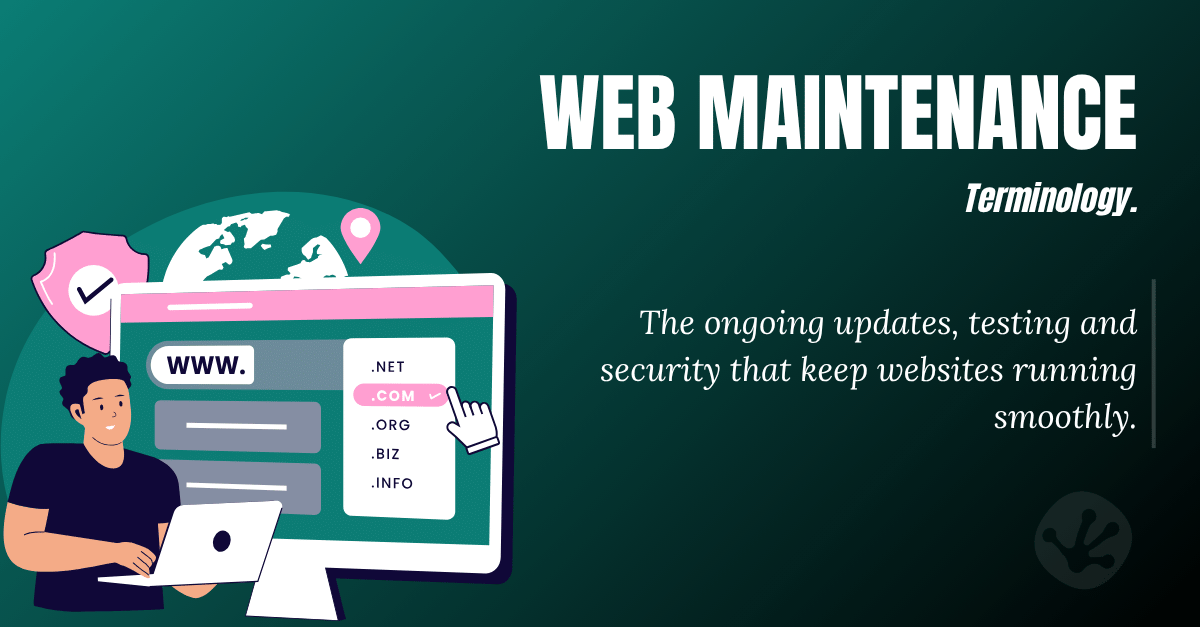
MAINTENANCE
The ongoing process of updating software, fixing issues, improving performance and keeping a website secure.
REDIRECT (301)
A permanent redirect that automatically sends visitors and search engines from one webpage to another.
STAGING WEBSITE
A private copy of a website used for testing changes before they are published to the live site.
UPDATE
Installing the latest versions of a website's software, themes or plugins to improve functionality, security and compatibility.
WEB DESIGN MADE SIMPLE
Whilst web design can seem full of technical terminology, understanding the basics makes working on a website project much more straightforward.
You don't need to learn how to code or become an expert in UX design to contribute valuable ideas. Simply understanding common terms like responsive design, wireframes, hosting, and SEO allows you to communicate more effectively with your web design team and make informed decisions throughout the project.
A successful website isn't built on attractive visuals alone. Careful planning, intuitive navigation, strong technical foundations and ongoing maintenance all play an important role in creating a website that performs well for both users and search engines.
At Treefrog, we believe great websites should be easy to understand as well as easy to use. Whether you're launching your first business website, redesigning an existing one or looking to improve your online presence, our team will guide you through every stage of the process and explain the terminology along the way, helping you create a website that not only looks fantastic but delivers measurable results.