
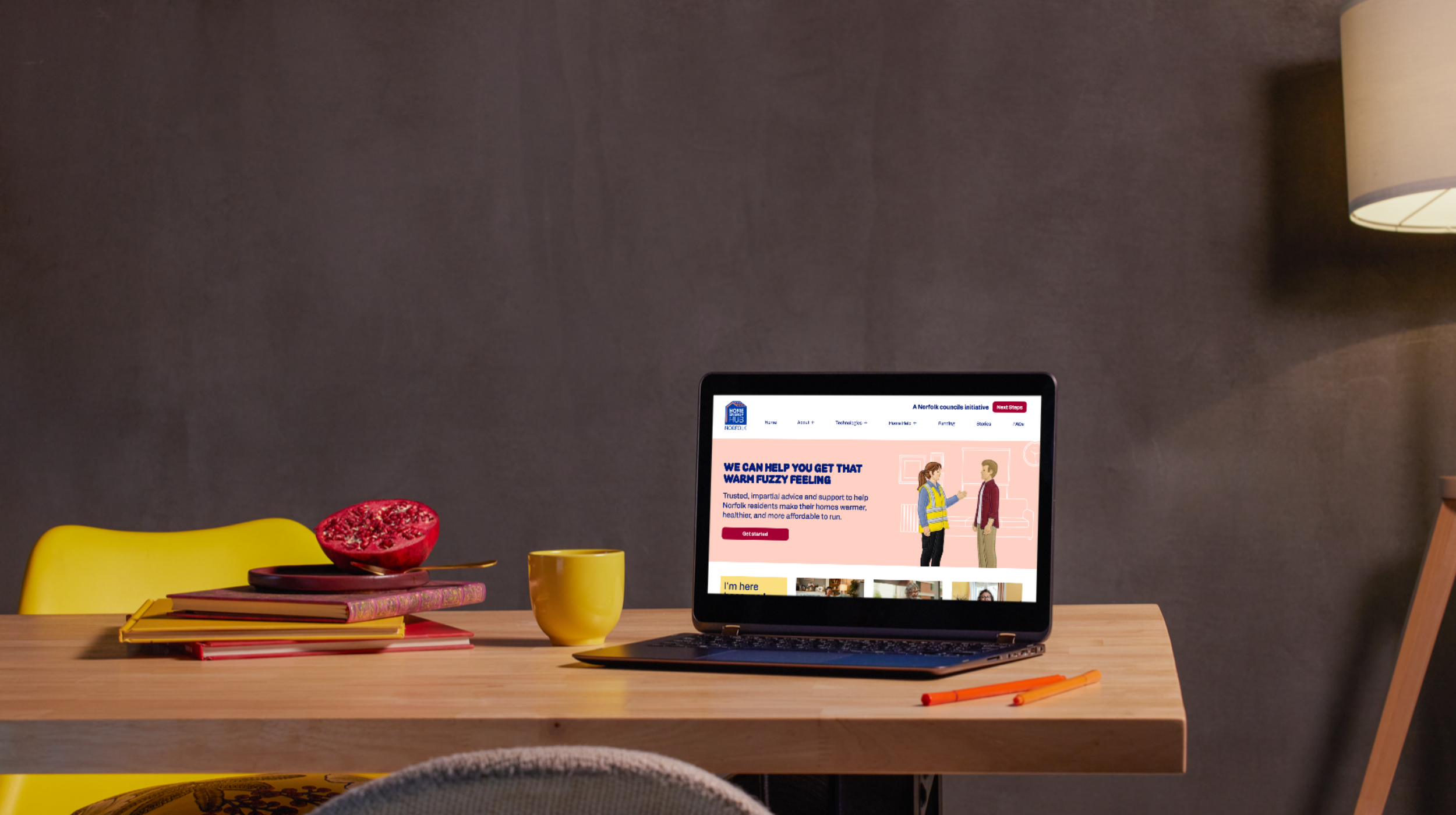
HOME ENERGY HUB NORFOLK
Creating a trusted digital platform to help Norfolk residents make their homes warmer, more energy efficient and cheaper to run
When the Norfolk Climate Change Partnership set out to create a new digital platform that would help residents understand home energy improvements, funding opportunities, and retrofit technologies, they launched a competitive public sector tender to find the right delivery partner.
Following a comprehensive procurement process, Treefrog was selected to deliver the project, recognising our integrated approach to branding, website design, content creation and video production.
Working closely with stakeholders from across Norfolk's local authorities, we developed Home Energy Hub Norfolk from the ground up. From creating the project's name and visual identity to designing and building the website, producing educational content and filming homeowner case studies, our team delivered a complete digital communications platform designed to inform, educate and inspire homeowners across the county.
Today, Home Energy Hub Norfolk provides residents with trusted, impartial advice, helping people make more informed decisions about improving the comfort and energy efficiency of their homes.
ABOUT THE PROJECT
Home Energy Hub Norfolk was developed on behalf of the Norfolk Climate Change Partnership to become the county's central online destination for trusted guidance on improving home energy efficiency.
Rather than promoting individual products or installers, the platform provides impartial advice designed to help residents understand their options, access funding opportunities, and make informed decisions about improving their homes.
Because the platform would serve thousands of residents with varying levels of knowledge and confidence, every aspect of the user experience had to prioritise clarity, accessibility, and trust.
THE CHALLENGE
Energy efficiency can be a confusing subject.
Heat pumps, insulation, solar panels, battery storage, grants, retrofit assessments, and funding schemes all involve technical language that many homeowners have never encountered before.
The challenge wasn't simply presenting information online. It was translating complex subjects into content that felt approachable, trustworthy and genuinely useful.
Alongside this, the project required collaboration with multiple stakeholders across Norfolk's local authorities, ensuring information remained accurate while maintaining a consistent voice and user experience throughout the website.
OUR APPROACH
Designing a platform around people, not technology
Before any design work began, we carefully planned how residents would interact with the platform.
Instead of organising information around technologies, we developed intuitive user journeys based on the questions people naturally ask.
Examples included:
I want to make my home warmer
I want to reduce my energy bills
I want renewable energy
I need financial support
I'm not sure where to start
This user-first approach helped transform what could have been an overwhelming collection of technical information into a simple and engaging online experience.
BRANDING AND IDENTITY
Creating a brand people could immediately trust
As a completely new initiative, Home Energy Hub Norfolk required a strong visual identity that felt impartial, welcoming, and credible.
Treefrog created the project name, logo, and supporting brand identity, establishing a consistent look and feel that would be recognised across the website, printed materials, video content, and future marketing campaigns.
Rather than feeling corporate or overly technical, the branding was intentionally designed to feel approachable and community-focused.
-
Understanding the Audience
Before any creative work began, we invested time in understanding who the platform was being built for. Home Energy Hub Norfolk needed to engage a diverse audience, from homeowners exploring renewable technologies for the first time to residents looking for financial support to improve the energy efficiency of their homes.
This research phase focused on understanding the motivations, concerns and expectations of the platform's future users. We considered the barriers that often prevent people from engaging with energy efficiency projects, including technical terminology, uncertainty around available technologies and confusion surrounding grants and funding opportunities.
Alongside audience research, we explored how similar organisations and government-backed initiatives presented themselves visually. We reviewed existing energy advice platforms, public sector campaigns and sustainability-focused brands to identify common themes, understand industry expectations and highlight opportunities to create something distinctive. Rather than replicating existing identities, this process helped us establish a clear direction for creating a brand that felt approachable, trustworthy and uniquely representative of Norfolk.
Developing Creative Concepts
With a clear understanding of the audience and project objectives, our design team developed four distinct creative directions.
Each concept explored a different visual approach while remaining aligned with the project's core goals. These included alternative logo concepts, colour palettes, typography, iconography, imagery styles and supporting graphic elements, each designed to communicate trust, accessibility and environmental responsibility in different ways.
Rather than presenting minor variations of the same idea, every concept represented its own creative vision and strategic direction. This allowed the project team to explore a range of possibilities and make informed decisions based on how they wanted the platform to be perceived by residents across Norfolk.
Every concept was accompanied by a rationale explaining the thinking behind the creative direction, ensuring stakeholders understood not only what each option looked like, but why particular design decisions had been made.
Collaborative Stakeholder Workshops
Once the concepts had been developed, we presented each direction to the project lead through a series of collaborative review meetings.
These sessions provided an opportunity to discuss the strengths of each concept, gather detailed feedback and understand how each visual identity aligned with the wider ambitions of the Norfolk Climate Change Partnership. As with many public sector projects, multiple viewpoints needed to be considered throughout the process, making open communication and collaborative decision-making essential.
Rather than treating feedback as a simple approval process, we used these meetings to refine the strategic direction of the brand, ensuring the chosen identity balanced stakeholder aspirations with the needs of the platform's future users.
Refining the Chosen Identity
Following the selection of the preferred concept, we entered a refinement phase where every element of the identity was reviewed and developed further.
Using stakeholder feedback, we refined the logo, typography, colour palette and supporting design system to ensure the final brand was both visually distinctive and practical across a wide range of applications. Consideration was given to how the identity would perform across digital platforms, printed materials, presentations, signage, video content and future campaign assets.
This iterative process ensured the final identity accurately reflected the project's values while providing the flexibility required for long-term use.
Creating the Brand Guidelines
With the final identity approved, we produced a comprehensive set of brand guidelines to support consistent use across all future communications.
The brand guidelines documented every aspect of the identity, including logo usage, colour specifications, typography, spacing, graphic elements, imagery guidance, iconography and tone of voice. This provided stakeholders and future contributors with a clear framework for maintaining a consistent and recognisable brand as the project continued to evolve.
Alongside the guidelines, we supplied a complete suite of production-ready assets in a range of formats suitable for both digital and print applications, ensuring the partnership had everything required to confidently manage the brand moving forward.
Presenting the Brand to Project Stakeholders
Once complete, the branding package was presented to the wider stakeholder group for final approval.
By clearly communicating the strategic thinking behind the identity, alongside practical guidance on how the brand should be applied, we helped ensure every organisation involved in the project shared a common understanding of how Home Energy Hub Norfolk would be represented across future communications.
This collaborative approach established a strong foundation for the remainder of the project and ensured consistency across all participating partners.
Establishing a Foundation for the Entire Project
The completed brand identity became the creative framework for every subsequent stage of the project.
The visual language, colour palette and typography informed the design and development of the website, influenced the production of video content and motion graphics, shaped the style of educational resources and provided a consistent visual identity across photography, printed materials and wider marketing collateral.
By establishing a clear and cohesive brand at the outset, every element of Home Energy Hub Norfolk worked together to create a unified experience that felt professional, trustworthy and instantly recognisable to residents across Norfolk.
WEBSITE DESIGN AND DEVELOPMENT
Building an accessible WordPress website for a diverse audience
The website was designed and developed in WordPress, providing the flexibility required for future expansion while allowing content to be easily managed by the project team.
Accessibility played a central role throughout development, ensuring residents of all ages and technical abilities could confidently navigate the platform.
Key considerations included:
Mobile-first responsive design
Clear navigation
Logical information architecture
Fast loading pages
Accessible layouts
Easy-to-understand content
Strong calls to action
Every page was built around helping users find answers quickly, regardless of where they entered the website.
-
User Experience Planning & Wireframing
The foundation of the website was built around user experience. Before any visual designs were produced, we created a series of wireframes and supporting planning documents that mapped out the structure of the website, user journeys and page hierarchy.
These wireframes were far more than simple page layouts. They documented the rationale behind every navigation decision, helping stakeholders understand not only what users would see, but why information had been organised in a particular way.
One of the key objectives was reducing the number of clicks required for residents to find relevant advice. Rather than expecting visitors to understand technical retrofit terminology, we designed the website around natural questions and self-identification pathways.
For example, instead of asking users to immediately choose between technologies such as solar PV, battery storage or insulation, the website encouraged residents to identify what they were trying to achieve.
This included journeys such as:
I want to make my home warmer.
I want to reduce my energy bills.
I want to improve my home's energy efficiency.
I want to generate renewable energy.
I'm not sure where to start.
By allowing users to self-identify their needs first, the website could guide them towards the most relevant information with minimal effort, creating a significantly more intuitive experience than a traditional technology-led navigation structure.
Alongside these journeys, we carefully considered page hierarchy, calls to action, navigation behaviour and internal linking to ensure visitors could confidently move throughout the platform without becoming overwhelmed.
Applying the Brand Identity
Once the wireframes and user journeys had been agreed, we began translating the approved Home Energy Hub Norfolk brand into a fully realised website design.
Using the visual identity developed during the branding phase, we introduced the project's typography, colour palette, iconography, imagery style and graphic elements throughout the interface. Every component was designed to reinforce the approachable and trustworthy nature of the initiative while maintaining consistency across the wider project.
Throughout this stage, designs were shared with project stakeholders for review and discussion. Feedback sessions allowed us to refine layouts, improve usability and resolve any inconsistencies before development began.
Rather than treating feedback as a final approval exercise, we worked collaboratively with the project team to continuously improve the user experience, ensuring the finished design reflected both stakeholder ambitions and the needs of Norfolk residents.
Website Development
Following approval of the design concepts, development began within WordPress.
The platform was chosen for its flexibility, scalability and ease of content management, providing the project team with a robust content management system that could continue evolving long after launch.
Templates were developed to provide consistency across the website while allowing different content types, including educational resources, funding information, technology guides and case studies, to be managed efficiently.
Responsive development ensured the website functioned seamlessly across desktop, tablet and mobile devices, while accessibility considerations remained central throughout the build. Navigation, layouts, typography and interactive elements were implemented with usability in mind, ensuring the platform remained accessible to the broad audience it was designed to serve.
Working Alongside Other Project Teams
With a fixed launch date approaching, website development became a collaborative effort involving multiple disciplines working in parallel.
While our development team built the website structure and functionality, our content specialists continued producing educational copy, and our video production team remained on location filming resident case studies, technology explainers and interviews with project partners.
This parallel workflow allowed each workstream to progress simultaneously, ensuring the website could be populated with high-quality written and visual content as it became available, rather than waiting for each element to be completed independently.
Regular communication between teams ensured new photography, videos and written content could be integrated into the website throughout development, allowing the platform to steadily evolve towards its launch-ready state despite a demanding project schedule.
Stakeholder Collaboration & Refinement
As development progressed, regular review versions of the website were shared with stakeholders across the partnership.
These review stages allowed us to gather detailed feedback on functionality, navigation, page layouts and content, ensuring every element of the website accurately reflected the project's objectives.
Working collaboratively with multiple organisations naturally generated a wide range of comments and suggestions. Our role was to carefully review this feedback, identify common themes and implement improvements that strengthened the overall user experience while maintaining consistency across the platform.
This iterative approach helped refine both the functionality and presentation of the website, ensuring the final product met the expectations of all project stakeholders before launch.
Content Population & Quality Assurance
As copywriting, photography and video production reached completion, content was carefully integrated throughout the website.
Every page was reviewed to ensure consistency of tone, formatting and visual presentation, while navigation and internal linking were continually tested to maintain a seamless user experience.
Alongside content population, we carried out comprehensive quality assurance testing across the website, checking responsive layouts, browser compatibility, links, forms and overall functionality to ensure the platform performed reliably across a wide range of devices.
SEO, Launch & Handover
As the project moved towards completion, we implemented the core on-page SEO foundations required to support long-term visibility within search engines.
This included optimising page titles, meta descriptions, heading structures, image alt text, search-friendly URLs and internal linking, ensuring the website launched with a strong technical foundation for future organic growth.
Following final stakeholder approval, the website was prepared for launch, deployed to its live hosting environment and made publicly available in line with the project's delivery schedule.
The result was a fully integrated digital platform that successfully combined branding, educational content, photography and video into a single, user-focused experience, providing Norfolk residents with an accessible and trusted resource while giving the Norfolk Climate Change Partnership a scalable platform capable of supporting the initiative for years to come.
VIDEO PRODUCTION
Bringing real residents’ experiences to life
Alongside the website, Treefrog produced a comprehensive collection of video content to help build trust and encourage engagement.
This included homeowner case studies, educational videos, and programme introductions that allowed residents to hear directly from people who had already improved their homes.
Authentic storytelling plays a vital role in public sector communications. By allowing real homeowners to share their experiences, the project became significantly more relatable than relying on written guidance alone.
-
Developing the Video Strategy
At the outset of the project, we worked collaboratively with the Norfolk Climate Change Partnership to determine the role video would play throughout the website and wider communications.
Together, we explored a range of possible approaches, considering how best to educate residents while building trust in the initiative. This included discussions around whether content should be organised primarily around individual technologies, geographical locations, funding schemes or personal stories.
Following these workshops, we agreed that the most effective approach would be to place real homeowner experiences at the heart of the project.
Rather than simply explaining how technologies such as air source heat pumps or solar panels work, we wanted residents to hear directly from people who had already undertaken home improvements themselves. By allowing homeowners to share their motivations, experiences and outcomes in their own words, the content would feel significantly more authentic, relatable and reassuring than a purely informational approach.
This storytelling-led strategy became the foundation for the entire video programme.
Planning the Production
Once the content strategy had been established, we worked alongside the project team to build a comprehensive production schedule covering every stage of filming.
This involved coordinating filming dates with homeowners across Norfolk, arranging interviews with representatives from partner organisations and local authorities, planning technology demonstrations and ensuring filming aligned with project milestones and website development.
Working across multiple locations and stakeholders required careful planning and ongoing communication, ensuring each filming day was organised efficiently while remaining flexible around residents' availability and operational requirements.
Throughout production, we maintained close contact with the project team, adapting schedules where necessary and providing regular updates as filming progressed.
Resident Case Study Production
The resident case studies became the centrepiece of the video campaign.
Across the project, we produced nine individual homeowner case studies, each showcasing a different property, technology and personal experience.
Before every filming session, we liaised directly with each resident to explain the filming process, answer any questions and ensure they felt comfortable participating. On arrival, we guided homeowners through the day's schedule, completed the necessary consent and release documentation, and discussed the story we hoped to capture before any cameras were set up.
Taking the time to build rapport was an important part of the process. For many participants, this was their first experience being interviewed on camera, so creating a relaxed and informal environment helped encourage natural conversation and authentic responses.
Each interview was structured around a carefully prepared set of questions, written in advance to guide the conversation while allowing residents the freedom to tell their own story in their own words. Rather than relying on scripted answers, this approach resulted in genuine conversations that reflected each homeowner's unique experience.
Alongside the interviews, we captured extensive supporting footage throughout each property. This included the technologies themselves, day-to-day interactions within the home, environmental details and wider contextual imagery that helped illustrate each resident's journey and create engaging visual storytelling.
Educational & Supporting Content
Alongside the resident stories, we produced a wider collection of educational videos designed to support the platform's learning objectives.
These included a flagship hero film introducing Home Energy Hub Norfolk and the wider aims of the initiative, helping visitors quickly understand the purpose of the platform and the support available to residents.
We also produced a series of technology explainer videos, simplifying complex home energy improvements into clear, easy-to-understand visual guides. These films complemented the written content throughout the website and provided an additional learning resource for visitors who preferred video-based information.
Recognising the wider impact of cold homes beyond energy bills alone, we also worked with healthcare professionals to produce a dedicated video exploring the relationship between warm homes and better health outcomes. Featuring NHS representatives, this content added further credibility to the platform while reinforcing the importance of home energy improvements from a public health perspective.
Together, these films created a balanced content library that combined education, personal storytelling and expert insight.
Editing & Collaborative Review
Following each filming session, all footage entered a comprehensive post-production process.
Interviews were carefully reviewed, stories refined and supporting footage edited together to create engaging films that aligned with the wider Home Energy Hub Norfolk brand identity. Graphics, titles, music, captions and visual elements were incorporated throughout to produce a consistent and professional viewing experience.
As with every stage of the project, post-production remained highly collaborative.
Draft edits were shared with the project team and wider stakeholders for review, allowing comments and feedback to be gathered before subsequent revisions were produced. Through multiple review stages, we refined each film to ensure both factual accuracy and creative quality before final approval.
This collaborative workflow ensured every video reflected the shared vision of the partnership while maintaining the high production standards expected throughout the project.
Publishing & Integration
Once approved, we supported the successful deployment of the video library across the wider platform.
We established and configured the client's dedicated YouTube channel, ensuring videos were organised appropriately and optimised for long-term management.
Each film was then embedded throughout the Home Energy Hub Norfolk website, allowing video content to sit naturally alongside the relevant educational pages, technology guides and resident case studies.
Using YouTube as the hosting platform provided a reliable, scalable and user-friendly solution while enabling the project team to continue managing and expanding their video library long after launch.
Delivering a Lasting Resource
In total, Treefrog delivered a comprehensive suite of video content that continues to support Home Energy Hub Norfolk as an educational resource for residents across the county.
Our video production included:
Nine resident case study films.
A flagship hero video introducing the initiative.
Multiple technology explainer videos.
A dedicated NHS-led film highlighting the importance of warm homes for health and wellbeing.
Interview planning and question development.
Full production scheduling and stakeholder coordination.
On-location filming across Norfolk.
Complete post-production, graphics and revisions.
YouTube channel creation, video optimisation and website integration.
By placing authentic stories at the centre of the content strategy, the finished video library helps transform technical guidance into engaging, human-centred communication that continues to educate, reassure and inspire residents considering improvements to their own homes.
PHOTOGRAPHY AND VISUAL CONTENT
Supporting every page with original photography
Professional photography was captured throughout the project to ensure the platform reflected real homes, real people and genuine improvements taking place across Norfolk.
Using original imagery rather than generic stock photography helped reinforce the credibility of the initiative while creating a more engaging experience for visitors.
-
Resident & Property Photography
Alongside filming the resident case studies, we captured a comprehensive range of photography at each location.
This included natural portraits of homeowners, lifestyle imagery within their homes and photographs showcasing the energy-saving improvements they had made. Capturing real residents in their own environments helped create a genuine connection with visitors, allowing the platform to feel personal and relatable rather than overly corporate or promotional.
Where appropriate, we also photographed the surrounding property and wider context, providing imagery that complemented both the written case studies and accompanying video content.
Technology & Solution Photography
Throughout production, we built a dedicated library of photography covering the various technologies featured across the platform.
This included professionally captured images of air source heat pumps, solar PV systems, battery storage, insulation and other home energy solutions. By photographing the technologies in real residential settings, we were able to support the educational content with imagery that demonstrated how these improvements look and function in everyday homes.
These photographs were used extensively throughout the website, helping to break up long-form content while giving residents a clearer understanding of the technologies being discussed.
Creative Asset Production
In addition to photography captured on location, we created a range of bespoke visual assets to support the wider campaign.
One of the most distinctive creative elements was the development of the project's "Warm Fuzzy Feeling" concept. To bring this messaging to life, we produced a series of custom visuals using handmade felt characters, creating a friendly and memorable visual theme that reinforced the campaign's approachable personality.
These original assets helped give the project its own recognisable identity while providing engaging imagery that could be used across the website and supporting communications.
Image Editing & Digital Artwork
Where additional supporting visuals were required, our design team produced bespoke graphics and composite imagery using Adobe Photoshop.
This included enhancing photography, creating supporting illustrations and producing custom visual assets that helped communicate concepts more clearly where photography alone was not suitable.
By combining original photography with professionally produced digital artwork, we were able to maintain a consistent visual style across the platform while ensuring every page was supported by high-quality, purpose-built imagery.
Supporting the Wider Project
Every photograph and visual asset was created with a clear purpose, whether supporting a resident case study, illustrating a specific technology or reinforcing the wider Home Energy Hub Norfolk brand.
Together, this visual content complemented the website, video production and written content, helping transform complex energy advice into a more engaging, accessible and visually cohesive digital experience.
CONTENT STRATEGY AND COPYWRITING
Creating an extensive library of educational content
One of the largest elements of the project involved producing comprehensive educational content covering every major aspect of home energy efficiency.
Treefrog researched, structured, and wrote content explaining topics including:
Air Source Heat Pumps
Solar PV
Battery Storage
Loft Insulation
Cavity Wall Insulation
Solid Wall Insulation
Roof Insulation
Ventilation
Funding Opportunities
Grants
Eligibility
Home Energy Advice
Frequently Asked Questions
Rather than writing for industry professionals, every page and print document was carefully produced using straightforward language that homeowners could confidently understand.
-
Content Strategy & Planning
Before writing began, we worked closely with the project team to plan the structure of the website and identify the information residents would need at each stage of their journey.
This involved mapping content to the user journeys developed during the website planning phase, ensuring residents could progressively discover information without becoming overwhelmed. Every page was written with a clear purpose, whether introducing a concept, explaining a technology, answering common questions or guiding users towards the next step.
By planning the content architecture alongside the website design, we ensured that navigation, page hierarchy and written content worked together to create a seamless user experience.
Researching Complex Technologies
A significant proportion of the project involved researching a wide range of home energy technologies and translating highly technical information into language that was easy to understand.
Our team produced detailed content covering topics including:
Air Source Heat Pumps
Solar PV
Battery Storage
Loft Insulation
Cavity Wall Insulation
Solid Wall Insulation
Roof Insulation
Ventilation
Smart heating controls
Energy efficiency measures
Grants and funding opportunities
This research drew upon trusted industry guidance, government resources and information provided by project partners, ensuring the final content remained technically accurate while avoiding unnecessary jargon.
The aim was not simply to explain how each technology worked, but to answer the questions homeowners were most likely to ask, including how suitable different solutions might be, what benefits they offered and what residents could expect throughout the process.
Downloadable Guides & Educational Resources
Alongside the website itself, we produced a series of downloadable technology guides designed to provide residents with more detailed information that could be saved, printed or shared.
These resources expanded upon the information available throughout the website, offering practical guidance in a clear and structured format while maintaining complete consistency with the Home Energy Hub Norfolk brand and tone of voice.
Creating these supporting documents ensured the platform became more than just a website, evolving into a valuable educational resource that residents could continue referring back to as they considered improvements to their homes.
Website Copywriting
Every page across the website was written by our team, from high-level landing pages through to detailed technology guidance, funding information and supporting educational content.
Throughout the copywriting process, we prioritised clarity, accessibility and readability. Technical terminology was carefully explained, complex concepts were broken into manageable sections and information was structured to help users quickly find the answers they were looking for.
Particular attention was given to headings, calls to action and page introductions, helping visitors understand where they were, what they would learn and where they should go next.
The result was a consistent tone of voice that felt informative without becoming overwhelming, balancing technical accuracy with straightforward, user-friendly language.
Interview Development & Storytelling
Content creation extended beyond the written website.
To support the resident case study videos, we developed interview structures and carefully prepared question sets designed to encourage authentic, conversational responses.
Rather than scripting participants, our questions were written to help residents naturally describe their experiences, motivations and the impact that home energy improvements had made to their lives.
This storytelling approach ensured the video content complemented the written guidance while adding a personal perspective that resonated with future homeowners considering similar improvements.
Collaborative Review Process
As with every stage of the project, content development was highly collaborative.
Draft copy was shared with project stakeholders for review, allowing subject matter experts to verify technical accuracy while ensuring messaging remained aligned with the wider objectives of the Norfolk Climate Change Partnership.
Feedback was gathered across multiple review stages, with revisions made where necessary to improve clarity, accuracy and consistency before publication.
This collaborative approach ensured the finished content reflected both the expertise of the project partners and the needs of the residents it was created to support.
A Consistent Voice Across the Entire Platform
With hundreds of pieces of content produced across webpages, downloadable guides, videos and supporting resources, maintaining consistency was essential.
Every piece of content was written using the same clear, approachable tone of voice, ensuring residents experienced a seamless journey regardless of whether they were reading a technology guide, downloading a factsheet or watching a homeowner case study.
By combining strategic planning, in-depth research and user-focused copywriting, we transformed complex technical information into an engaging educational resource that continues to support homeowners across Norfolk in making informed decisions about improving the comfort, efficiency and sustainability of their homes.
THE DELIVERABLES
A fully integrated public sector communications project
Unlike many digital projects that focus on a single discipline, Home Energy Hub Norfolk brought together multiple specialist services into one cohesive delivery.
Treefrog provided:
Brand Strategy
Naming
Logo Design
Brand Guidelines
WordPress Development
UX Design
Information Architecture
Copywriting
Educational Content
Photography
Case Study Production
Accessibility Best Practice
THE RESULT
A trusted digital resource for Norfolk homeowners
Today, Home Energy Hub Norfolk provides residents across the county with a single destination for impartial advice, practical guidance and educational resources relating to home energy efficiency.
By combining thoughtful user experience design, clear copywriting, engaging video content, and an approachable visual identity, the platform helps residents feel more confident when exploring ways to improve their homes.
The project demonstrates how effective digital communication can simplify complex subjects, improve accessibility, and increase engagement within large-scale public sector initiatives.
-
“Treefrog have been an exceptional partner from start to finish. They brought real creativity, attentiveness and flexibility to a complex brief: designing and building a new multi‑agency public‑sector website — now live as the Home Energy Help Hub Norfolk — and delivering it all within an ambitious 12‑week timeframe.
They took the time to understand the needs of several councils and partner organisations, each with different priorities and governance requirements. Despite the number of stakeholders involved, Treefrog remained consistently responsive, thoughtful and solutions‑focused. Their ability to listen carefully, adapt quickly and translate feedback into clear, user‑centred design choices made a huge difference to the project.
What stood out most was how genuinely nice they were to work with. They brought good humour, patience and a calm, collaborative approach to every stage of the build. Nothing was ever too much trouble, even when requirements shifted or timelines tightened. They made a complex project feel manageable — and even enjoyable.
The final site reflects their skill, care and commitment: accessible, modern and built around the needs of residents. Delivering this in just 12 weeks is a testament to their capability and their dedication to getting it right.
We’re incredibly grateful for the quality of their work and would not hesitate to recommend Treefrog for future multi‑agency digital projects.”
WHY THIS PROJECT MATTERS
Home Energy Hub Norfolk represents exactly the kind of integrated project Treefrog loves delivering.
Rather than simply building a website, we helped create an entire digital ecosystem designed to educate, inform, and inspire positive action.
By combining branding, strategy, website design, content creation, video production and photography under one roof, we were able to deliver a consistent experience across every stage of the project.
Whether we're working with local authorities, charities or commercial organisations, our approach remains the same: understand the audience first, communicate clearly, and create digital experiences that genuinely make a difference.
SELECTED VIDEOS
THE CLIENTS
NORFOLK COUNTY COUNCIL
.
NORWICH CITY COUNCIL
.
SOUTH NORFOLK COUNCIL
.
BRECKLAND COUNCIL
.
BROADLAND COUNCIL
.
GREAT YARMOUTH BOROUGH COUNCIL
.
BOROUGH COUNCIL OF KINGS LYNN AND WEST NORFOLK COUNCIL
.
NORTH NORFOLK DISTRICT COUNCIL
.
NORFOLK COUNTY COUNCIL . NORWICH CITY COUNCIL . SOUTH NORFOLK COUNCIL . BRECKLAND COUNCIL . BROADLAND COUNCIL . GREAT YARMOUTH BOROUGH COUNCIL . BOROUGH COUNCIL OF KINGS LYNN AND WEST NORFOLK COUNCIL . NORTH NORFOLK DISTRICT COUNCIL .
Looking to Deliver a Similar Project?
If you're planning a public sector campaign, educational platform, or large-scale digital communications project, we'd love to hear about it.
Whether you need branding, website design, content creation, video production or a complete end-to-end solution, Treefrog can help transform complex information into engaging digital experiences that people genuinely use.